
The 30-Day Micro-Saving Challenge That Helped Me Save ₹5,000 ( Effortlessly )
Let’s be honest — saving money sounds great until we actually try doing it.
Most of us promise ourselves, “I’ll start next month,” but the month slips away between UPI payments, coffee runs, and those “just ₹199” online deals.
A few months ago, I was stuck in that loop — I decided to test something simple — a 30-Day Micro-Saving Challenge to see if I could save ₹5,000 without cutting my favorite things.
What if I could save ₹5,000 in 30 days — without cutting out my favorite things?
That’s how my 30-Day Micro-Saving in india Challenge began.
No complicated budgeting apps, no giving up coffee — just small, clever tweaks to my daily habits.
And surprisingly, it worked.
In this post, I’ll share exactly how I did it — step-by-step — along with insights, real examples.
💡 What Is the “30-day Micro-Saving Challenge” Concept?
30-days Micro-saving means saving small amounts regularly — without feeling the pinch.
Instead of cutting major expenses, you make small, smarter decisions that compound over time.
Think of it as:
“Less sacrifice, more mindfulness.”
Here’s how it works:
| Concept | Description | Real-Life Example |
|---|---|---|
| Micro-Action | daily money save ₹10–₹200 | Making home coffee instead of buying one |
| Frequency | Daily or weekly habit | Saving ₹100 a day = ₹3,000 a month |
| Automation | Setting small auto-transfers | Using UPI auto-debit to a savings wallet |
| Awareness | Tracking small leaks | Checking unnecessary subscriptions |
These small wins add up fast.
Also read – One-Week cash only challenge Guide.
How To Start 30-Days Micro-Saving Challenge:
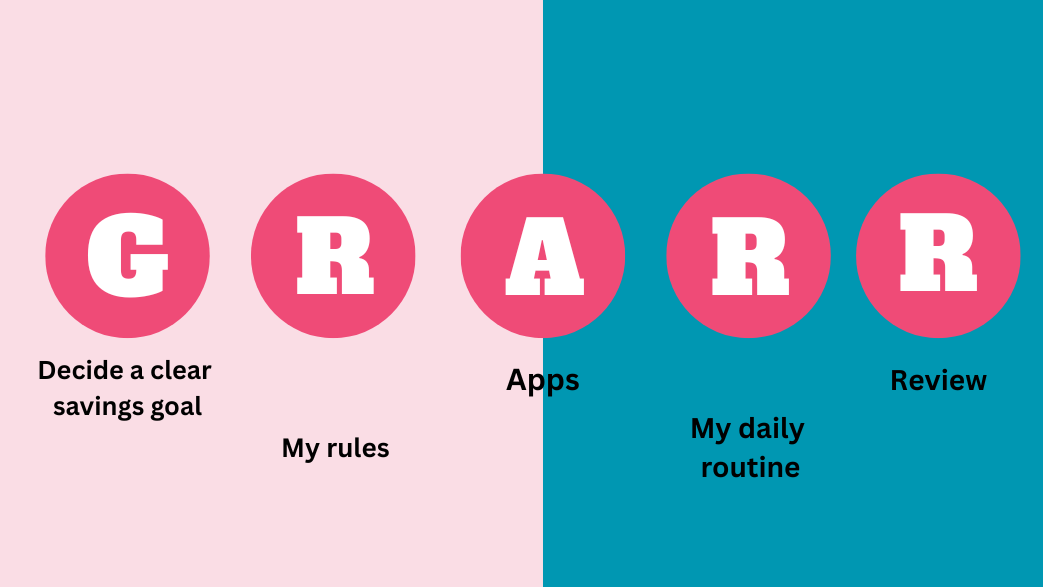
In 30-Day Micro-Saving Challenge? Here’s the exact process that helped me stay consistent.
Step 1 — Set a clear yet realistic goal
You need one number to aim at. I chose ₹5,000 in 30 days because it’s concrete and motivating.
How to decide your target:
- Look at your last month’s variable spending (food, snacks, rides, entertainment).
- Choose a target that’s around 2–6% of your monthly income or a round figure that motivates you.
Why a concrete goal helps: a number focuses your mind. Instead of vague “save more,” I aim for “₹167/day” (₹5,000 ÷ 30).
Step 2 — Choose your micro-saving rules (my exact rules)
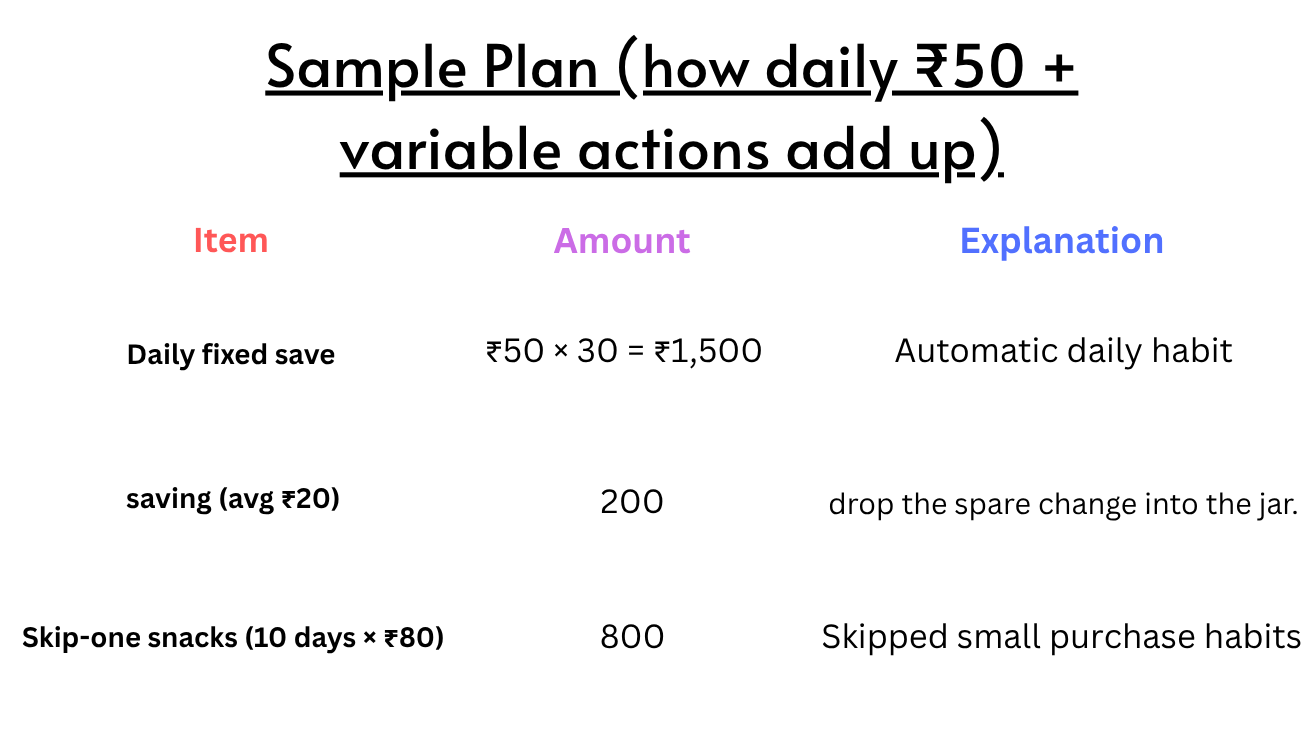
I used a mix of rules so the plan felt flexible:
Fixed action (daily):
- Put ₹50 into the jar each day.
Why: A daily habit builds momentum and feels doable.
Variable actions (choose any each day):
- Round-up rule: Round purchases to the nearest ₹10/₹20 and drop the spare change into the jar.
- Skip-one rule: Skip one impulse snack or delivery per day; add that amount to savings.
- Auto-save windfall: Add half of any small unexpected money (gift, cash reward).
This mix gave me structure plus flexibility: some days I added the fixed ₹50 and nothing else; other days I added several small round-ups.
Step 3 — Tools — what I used to track (minimal friction)
You don’t need fancy apps. I used:
- One clear jar for visibility.
- A notebook for daily entries (Date – Action – Amount).
- A simple spreadsheet (optional) to auto-sum weekly totals.
Simple daily tracker format
| Date | Action (fixed/variable) | Amount | Running total |
|---|---|---|---|
| Day 1 | Daily ₹50 | ₹50 | ₹50 |
| Day 2 | Round up ₹8 | ₹8 | ₹58 |
| … | … | … | … |
| Day 30 | Bonus ₹200 | ₹200 | ₹5,000 |
Practical tip: Put the jar in a visible place.
Step 4 — The daily routine (exact walk-through of one day)
Here’s a realistic day I followed:
- Morning: Fixed save — drop ₹50 into jar. (Habit cue: after brushing teeth.)
- Afternoon: Bought lunch — rounded up ₹12 (saved in separate coin dish).
- Evening: Felt urge to order dessert, paused, checked jar — decided to skip, saved ₹100.
- Night: Logged actions in notebook (Day X: ₹50 + ₹12 + ₹100 = ₹162).
That night I updated the spreadsheet and felt good. Small, visible wins build morale.
Step 5 — Weekly review: what to check and how to adjust
Every 7 days I did a 15-minute review:
- Add totals for the week.
- Mark the biggest leak (category where I failed).
(Quick Insight) – What I Learn
🗓️ Week 1: The Awareness Phase — “Where Does My Money Go?”
Before saving, I tracked every expense for a week.
I didn’t change anything — I just watched.
Here’s what I found:
| Category | Daily Avg | 7-Day Total |
|---|---|---|
| Snacks & Drinks | ₹150 | ₹1,050 |
| Online Subscriptions | ₹100 | ₹700 |
| Transportation | ₹120 | ₹840 |
| Impulse Shopping | ₹200 | ₹1,400 |
In Week 1 of my 30-Day Micro-Saving Challenge, awareness was the biggest win.
➡️ Total leaks in a week: ₹3,990
That’s almost ₹16,000 a month — just vanishing into “small” things.
This step was uncomfortable, but it opened my eyes.
I realized — saving wasn’t about earning more; it was about paying attention.
🗓️ Week 2: The Round-Up Rule — “Save Without Noticing”
By week two, the 30-day Micro-Saving started feeling natural — like brushing my teeth daily.
I used a simple round-up trick:
Every time I spent money, I rounded the amount up to the next ₹10 or ₹50 — and transferred the difference into my savings account.
Example:
- ☕Coffee: ₹145 → I saved ₹5
- 🛺Auto fare: ₹180 → I saved ₹20
- 👜Online purchase: ₹1,249 → I saved ₹51
At the end of each day, I’d note how much I rounded up.
It felt effortless — and by the end of week two, I’d saved ₹1,200 passively.
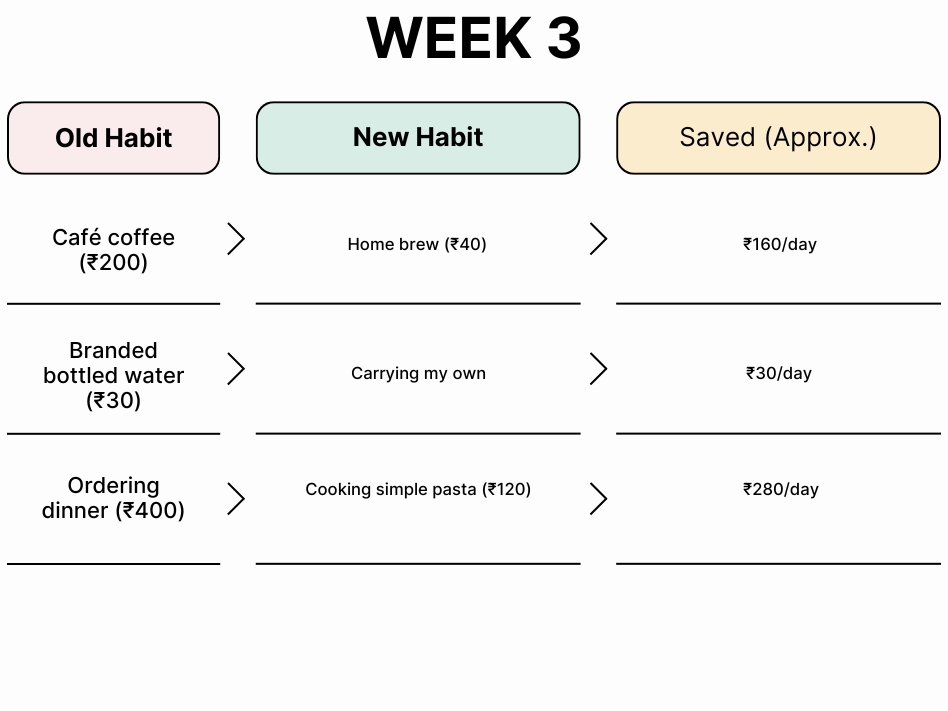
🗓️ Week 4: The Auto-Save Habit — Let Technology Work for You
By Week 4, this 30-day Micro-Saving had become an automatic part of my daily life.
I automated savings.
I set ₹150/day auto-transfer to a small savings account.
It was like paying a small “self-bill” daily — I didn’t even notice it.
By the end of 30 days, my auto-savings + round-ups totaled ₹5,000+.
30-Day micro-Saving challenge Summary
Here’s what I achieved through my 30-Day Micro-Saving Challenge in just a month — no strict sacrifices, just mindful tweaks.
| Source | Amount Saved |
|---|---|
| Round-up rule | ₹1,200 |
| Smart swaps | ₹2,000 |
| Auto-saving | ₹1,500 |
| Eliminating unused subscriptions | ₹300 |
| Total | ₹5,000 ✅ |
I also try digital payments vs cash which is better for my daily spendings.
( Personal Insights ) and Lessons I Learn
What this 30-Day Micro-Saving truly taught me was self-awareness.
I want to be honest here—these simple lessons are more important than money.
What surprised me:
- Small interruptions (counting cash, checking jars).
- I didn’t feel any lack. Conscious choices eliminated the “need” to buy a lot.
- The momentary pause before a purchase became the strongest habit: even a 30-second question—”Is this worth ₹X?”—prevented many impulse purchases.
- I didn’t feel any lack. Conscious choices eliminated the “need” to buy a lot.
What was most difficult?
- Social situations: Birthday parties, where you feel pressure to spend.
- Habit relapse: Weekends were more risky. I planned a paid treat weekend to avoid overindulging.
What worked best:
- Specified daily savings—consistency trumps intensity.
- Visual progress: The jar and weekly totals kept me motivated.
Quick FAQ (Frequently Asked Questions)
Q: Is ₹5,000 realistic for everyone?
Ans. Adjust daily and weekly amounts based on your income.
Q: What if I fail mid-month in 30-day micro-saving challenge?
Ans. Restart next day. Progress matters, not perfection.
Q: Can I use apps instead of a jar?
Ans. Absolutely! Use whatever keeps you most accountable — app or cash, both work.
Conclusion
If you ask me what mattered most, it wasn’t the math — it was awareness.
This simple 30-day micro-saving challenge opened my eyes to how tiny, invisible expenses quietly drain money — and how small, consistent actions can control money habits.
💰 ₹5,000 in 30 days isn’t magic.
It’s just the result of discipline + intention + honesty.
🎯 Set goals that don’t hurt –
🧾 Track honestly
📱 Cut digital clutter
⏳ Stay consisten
This 30-day micro-saving experiment quietly improved not only my finances, but also my focus and discipline.
Less scrolling, fewer impulse buys, and more intention in how I use my time and money.
We’re not professional financial advisors — just regular people trying to build better money habits. This post shares personal experiences and ideas that worked for us. For more useful advice, check out our Telegram channel.
