
I Try One Week Cash-Only Challenge in India – Feel Real Money Again & Save Smarter [2025 Guide]
Honestly, I never thought cash could teach me anything new. I was used to tapping my phone or card for everything — tea, snacks, groceries, subscriptions — it was just convenient.
But last year, during one of my “budget reset” attempts, I decided to go one week cash-only challenge.
And I won’t lie — the experience completely changed my perspective on spending.
The first thing I noticed?
Every time I pulled a ₹100 note from my wallet, it hurt just a little — not in a bad way, but in a wake-up way.
That single week helped me understand something that years of financial advice couldn’t —
how digital payments make money feel invisible, and how physical cash brings awareness back.
This post we’ll talk about — what the One Week Cash-Only Challenge is, why it works psychologically, how to do it step by step, real-life lessons I learned, and how you can make it a long-term habit without stress.
💡 What Is the One Week Cash-Only Challenge?
The one week Cash-Only Challenge is a simple 7-day personal experiment.
You stop using digital payments entirely — no cards, no UPI, no mobile wallets.
instead, you withdraw a fixed amount of cash for the entire week and spend only from that.
For example, if you usually spend ₹3,500 a week, take out ₹3,000 in cash and challenge yourself to live within that amount.
This small experiment helps you see money again.
You feel every payment, count every note, and actually watch your wallet get lighter.
That’s awareness — and that awareness is what most of us lose in a cashless world.
🧠 Why is one week cash-only challenge so effective?
Here’s the psychology behind it—and why it’s surprisingly effective:
1. Cash creates connection:
When you hand over a ₹500 note, your brain actually feels the “loss.” That tiny discomfort prevents reckless spending.
2. Digital feels unreal:
Swiping or tapping doesn’t feel like money leaving you. That’s why it’s so easy to overspend without realizing.
3. You focus on small purchases:
A ₹30 tea or ₹70 snack might seem small — but with cash, you see how fast those “tiny” spends pile up.
4. It creates self-discipline:
With a limited wallet, you naturally prioritize what’s essential. It’s not restriction — it’s awareness.
Before trying the One Week Cash-Only Challenge, I also try 30 Day Micro Saving Challenge.
🪜 Step-by-Step: How to Start the One Week Cash-Only Challenge
Let’s go deep into how to actually do it — not just in theory, but in a realistic, easy way.
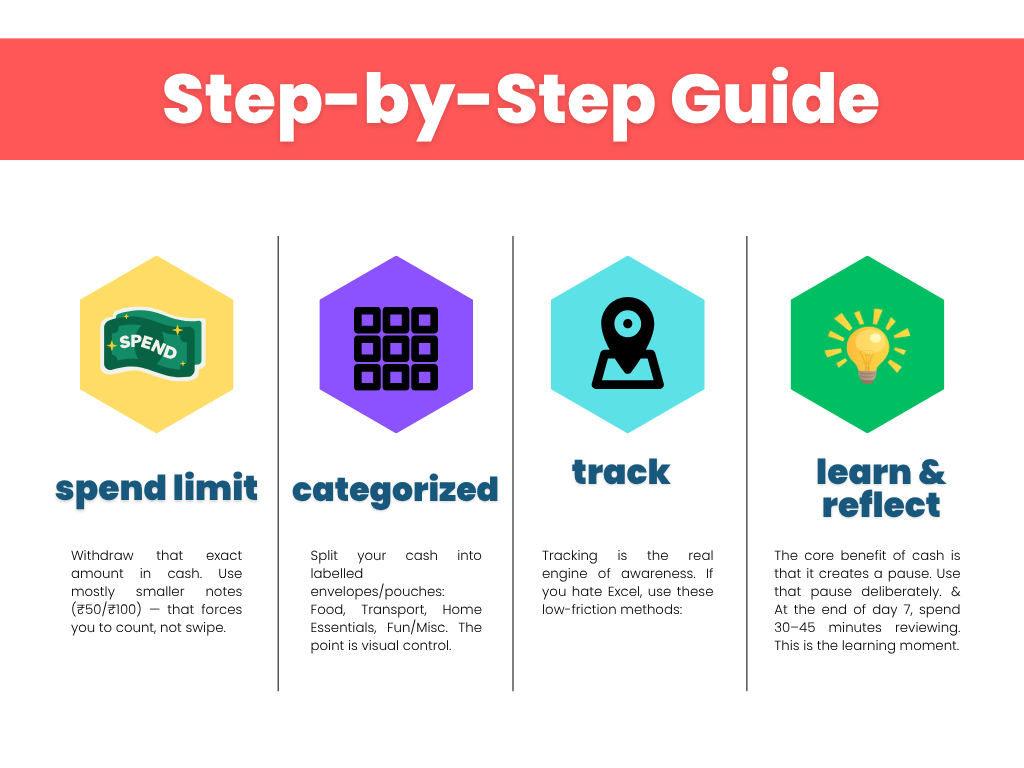
1. Decide your weekly spending limit — realistically and kindly
Don’t guess — calculate. For a realistic number:
- Look at the last month’s bank/UPI/card history. Add up your variable weekly costs (groceries, transport, snacks, small purchases).
- Take that weekly average and reduce it by about 10–15% for the challenge (too low = stress; too high = no learning).
- Withdraw that exact amount in cash. Use mostly smaller notes (₹50/₹100) — that forces you to count, not swipe.
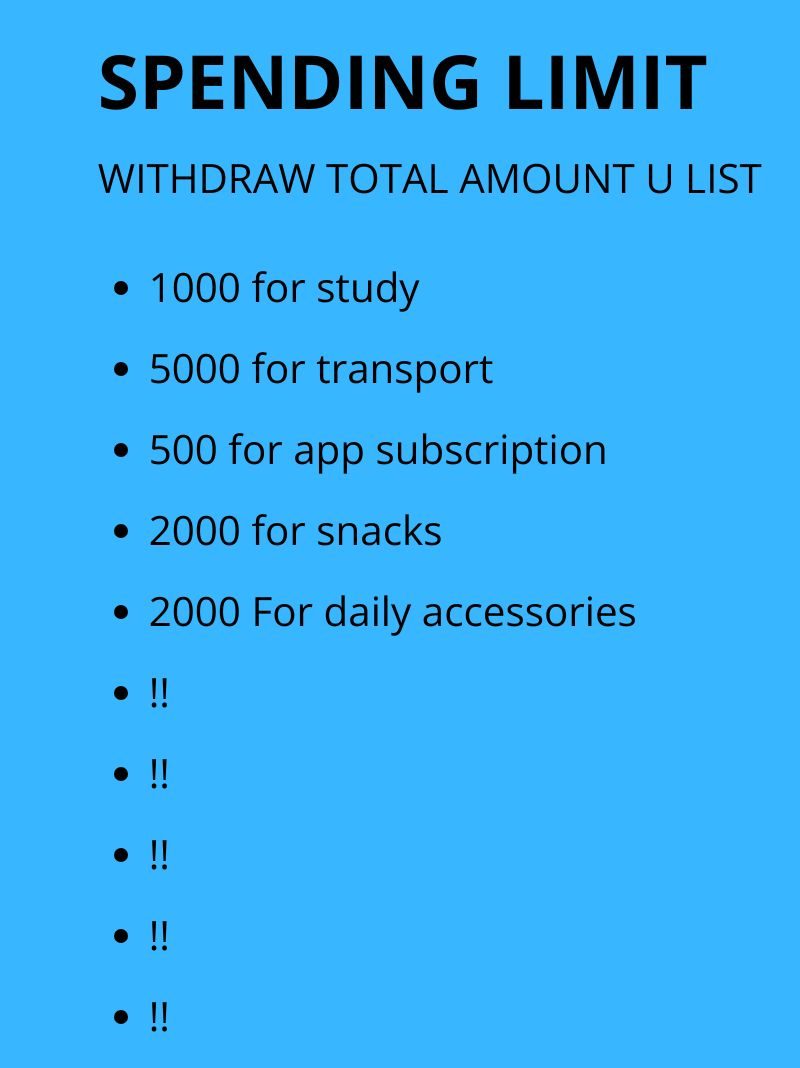
Example: If your average weekly variable spending = ₹4,000 → try ₹3,400 (15% cut) for the first week.
Micro-rule: If you already have planned big expenses (medicine, bill, travel), keep them separate and pre-funded — the challenge tests daily discretionary spending, not essentials.
2. Categorized the cash
Split your cash into labelled envelopes/pouches: Food, Transport, Home Essentials, Fun/Misc. The point is visual control.
How to split:
- 🍎Food & Groceries — 40% of your cash
- 🚌Transport — 20%
- 🎬Personal/Leisure — 20%
- ⚡Emergency buffer — 20%
Example: ₹3,400 becomes: Food ₹1,360 | Transport ₹680 | Leisure ₹680 | Buffer ₹680.
Practical tip: Put the smallest envelope (Leisure) in your front pocket and the Food envelope at home. That minor friction reduces impulse cafe stops.
When the envelope runs out: Reassess — don’t borrow from another category unless it’s truly essential (medicine, urgent transport). Each decision teaches you where your blind spots are.
3. Track Every Rupee You Spend
If there’s one habit that makes the One Week Cash-Only Challenge truly work, it’s tracking every single rupee you spend.
- A pocket notebook with three columns: Date — Item — Amount. At night total it.
- Or use a single phone note with a running daily total (not the app with pie charts — that’s overkill for a week).
| Day 2 🚌Bus ₹20 🍞Breakfast ₹60 🍉Fruit ₹40 Total day = ₹120 |
Why nightly? Immediate memory, small effort, and the daily total helps you course-correct the next day.
Pro tip: On day 3, compare the first three daily totals. If one category spikes (e.g., snacks), you know where to cut.
4. Learn to pause
One of the most powerful parts of the One Week Cash-Only Challenge is learning to pause before you pay.
Cash naturally slows you down — and that small pause is where awareness begins.
When you hold real notes in your hand, your brain gets a tiny window to think — “Do I really need this?”
It’s not about saying no to everything; it’s about saying yes consciously.
Everyday examples:
- Want a cold drink after class? Check your Drink envelope. If less than ₹30 remains, ask: “Can I drink water and save ₹30?”
- Want to order food because you’re tired? Check the Food envelope and ask if cooking leftovers will do.
Mental trick: Imagine the item as a choice between “now” and “later.” If “later” is more valuable (bigger goal), skip “now.”
5. Reflect Deeply at the End of the one week cash-only challenge
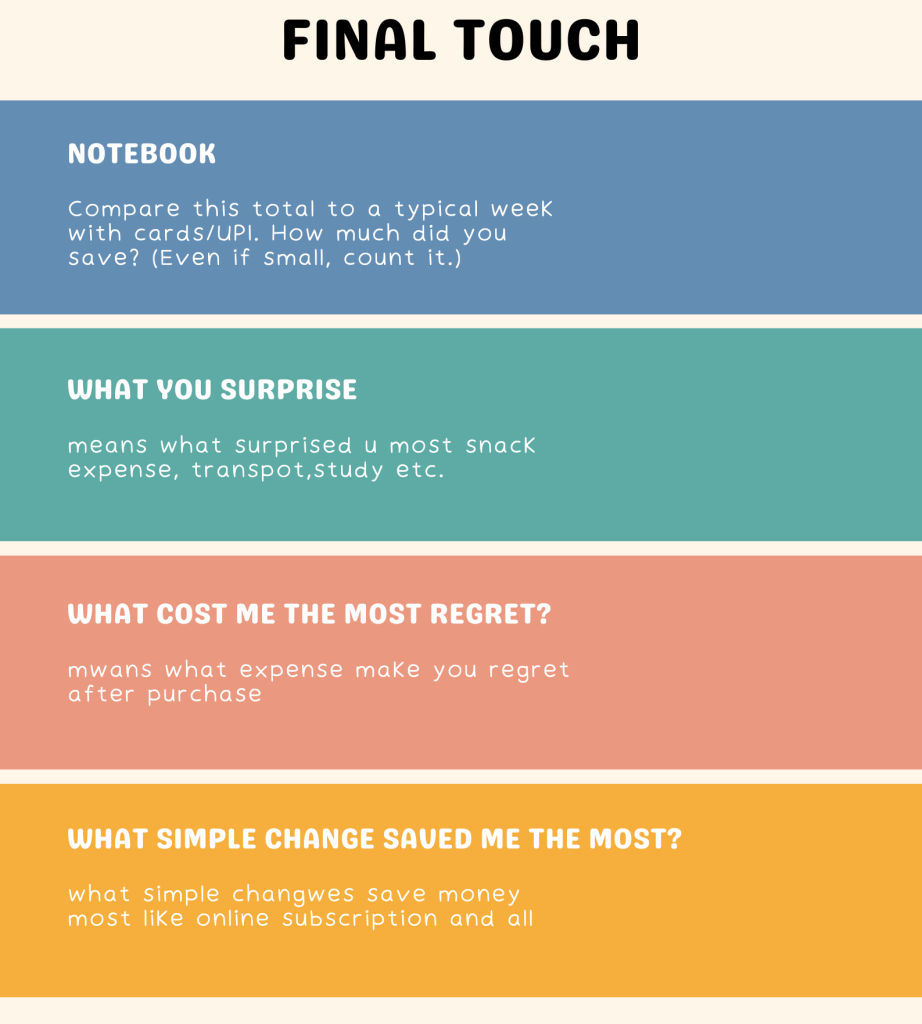
At the end of day 7, spend 30–45 minutes reviewing. This is the learning moment.
What to do:
- Add up totals from your notebook.
- Compare this total to a typical week with cards/UPI. How much did you save? (Even if small, count it.)
- Ask three quick questions and write one honest sentence answer for each:
- What surprised me?
- What cost me the most regret?
- What simple change saved me the most?
Repeat frequency: Do the one-week challenge once a month, or once a quarter if monthly feels heavy.
Also learn how- Reducing App Overload Help Save Money.
💬 My Personal Experience (What I Learned the Hard Way)
I’ll be honest — by day three of the one week cash-only challenge, I wanted to quit.
I ran out of cash at a cafe and instinctively reached for my phone. But then I stopped — and realized, that’s the problem.
We’re so used to convenience that we forget how easy it is to spend thoughtlessly.
By the end of the week, I had ₹600 left. Normally, I would have nothing.
And the biggest shock? I didn’t feel deprived at all — I just became more selective.
That one week of the one week cash-only challenge permanently changed how I handle money.
Now, even when I pay online, my brain automatically asks — “Would I still buy this if I had to hand over cash?”
| Day | Emotion Felt | Key Realization | Habit Shift |
|---|---|---|---|
| Day 1 | Overconfident | I underestimated my small spends | Awareness begins |
| Day 3 | Frustrated | I missed my UPI comfort | Learned to prioritize |
| Day 5 | Calm | Spent less on impulse | Started tracking daily |
| Day 7 | Proud | Under budget! | Realized I don’t need to overspend |
That’s real progress.
💰 Benefits of the one week Cash-Only Challenge (with Real Impact)
Let’s go deeper into what really changes after doing this for a week.
- You Feel Money Again: Every note has weight. That small physical connection resets your brain’s relationship with spending.
- Impulse Control Increases: No more random UPI spends or “limited time offer” traps. Cash makes you pause — and that pause saves you.
- Instant Gratitude: You start appreciating what you buy because you chose it consciously.
- Awareness Builds Discipline: You realize exactly where your weak spots are — be it food delivery, subscriptions, or unnecessary online buys.
For the first time in a long while, I knew exactly where my money went, and more importantly… why it mattered.
💭 Mistakes I Do During the One Week Cash-Only Challenge:
When I started the one week cash-only challenge, I thought it would be easy — just stop using digital payments. But within a few days, I realized how tricky it actually was.
| Mistake | What Happened | Lesson Learned |
|---|---|---|
| 💸 Unrealistic limit | I set too low a budget and got stressed. | Start with comfort; lower slowly. |
| 📱 Mixing digital & cash | One digital payment broke my streak. | Commit fully for 7 days. |
| 🍴 Ignoring tiny spends | Snacks drained my wallet. | Track every coin. |
| 📔 Skipping tracking | Missed two days → confusion. | Track daily at night. |
| 🧍 Being too strict | Felt guilty over mistakes. | Focus on awareness, not perfection. |
Quick FAQ (Frequently Asked Questions)
Q: Can I mix digital payments during the challenge?
A: No, avoid it for 7 days — the goal is awareness, not convenience.
Q: What if I fail midweek?
A: No problem! Restart next week. Progress matters more than perfection.
Conclusion
Honestly, when I began one week cash-only challenge, I thought it would just be a cute little experiment — something to “test my discipline.”
But by the end, it made me rethink my entire relationship with money.
If I could give you one piece of advice, it would be this:
👉 Try it once, genuinely. Not for perfection, but for awareness.
It wasn’t easy — there were moments of frustration, small slips, and self-realization. But that’s the beauty of it.
Because this isn’t just about money — it’s about mindset.
One week of cash taught me more about myself than months of budgeting apps ever could.
And the best part? The awareness stays with you — long after the week ends. -For more useful advice, check out our Telegram channel.
